
Aerodynamics is one of the most crucial elements in designing performance sports cars. It impacts how a vehicle accelerates, handles, and maintains stability at high speeds. Aerodynamics refers to the way air flows around a car and interacts with its various components, influencing drag, downforce, and overall performance. In sports car design, engineers take special care to ensure that the aerodynamic properties of the car are optimized for speed, control, and safety. This blog will explore how aerodynamics affects sports car performance, key features that influence speed and handling, and why it’s essential for high-performance driving.
What Is Aerodynamics and Why Does It Matter for Sports Cars?
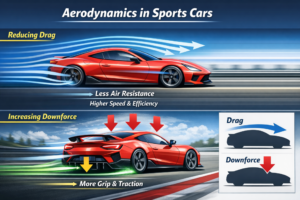 Aerodynamics is the study of how air flows around objects, particularly moving objects like cars. When applied to performance sports cars, aerodynamics is crucial because it reduces the resistance caused by air as the vehicle moves forward, allowing the car to reach higher speeds more efficiently. Additionally, it improves handling by ensuring that the car stays planted to the road, even at high speeds or during sharp turns.
When designing sports cars, manufacturers focus on reducing drag and increasing downforce, two key components of aerodynamics that significantly affect a vehicle’s speed and handling. Drag is the resistance air creates as it flows against the car’s surface, while downforce is the force that pushes the car down onto the road, improving tire grip and traction.
The Role of Drag in Sports Car Performance
Drag is a major obstacle to achieving high speeds. It’s the air resistance that acts opposite to the motion of the car, slowing it down. In performance sports cars, drag is minimized to ensure that the car reaches its top speed with minimal energy loss. Drag is influenced by the shape of the car, its surface texture, and the interaction between the car and the surrounding air. Designers carefully shape the body of the car to reduce drag, using smooth, flowing curves that allow the air to move easily around the vehicle.
One of the most effective ways to reduce drag is by optimizing the car’s shape, often by designing it to be as streamlined as possible. The smaller the drag, the less effort the engine needs to exert, leading to better fuel efficiency and faster acceleration. This is why high-performance cars often have sleek, aerodynamic designs with low ground clearance and sharp edges that allow air to flow smoothly along the body of the car.
Downforce: The Key to Better Handling and Stability
While reducing drag is crucial for speed, downforce is vital for handling. Downforce is the aerodynamic force that pushes the car toward the ground, increasing tire traction and allowing the car to grip the road better. At high speeds, a lack of downforce can lead to instability, causing the car to lose control during tight corners or braking. By increasing downforce, designers ensure that the tires maintain optimal contact with the road, improving grip and stability.
Sports car manufacturers achieve downforce using various aerodynamic features, including front splitters, rear spoilers, and diffusers. These components are carefully placed to manipulate airflow and direct air in such a way that it enhances the car’s grip on the road. As a result, the car can corner faster, brake more effectively, and remain stable even when driving at high speeds.
Key Aerodynamic Features in Sports Cars
There are several key features that enhance the aerodynamics of performance sports cars. Each of these components serves a specific purpose in reducing drag, increasing downforce, or improving airflow. Here are some of the most common aerodynamic features found in high-performance sports cars:
- Front Splitters: A front splitter is a horizontal piece of equipment mounted at the front of the car, designed to direct airflow around the vehicle and create additional downforce.
- Rear Spoilers: Rear spoilers work by redirecting airflow over the car, reducing lift and increasing downforce at the rear of the vehicle.
- Diffusers: Located at the rear underside of the car, diffusers help accelerate airflow beneath the car, enhancing downforce and improving stability.
- Side Skirts: Side skirts are located on the lower sides of the car, creating a smooth flow of air underneath and preventing turbulent airflow, which reduces drag.
- Rear Wings: Rear wings are larger spoilers designed to maximize downforce. They are often adjustable to provide the right level of downforce based on the car’s speed.
How Active Aerodynamics Are Changing the Game
 Active aerodynamics is a cutting-edge technology that allows certain aerodynamic components of a car to adjust automatically based on driving conditions. For example, rear spoilers or front splitters can change their angles depending on the car’s speed and braking forces. This helps the car maintain optimal aerodynamic performance at all times, ensuring both speed and stability. Active aerodynamics is a technology that is becoming more common in modern sports cars, as manufacturers seek to provide the best possible driving experience.
For instance, at higher speeds, the rear spoiler may increase its angle to generate more downforce, providing better grip on the track. At lower speeds, the spoiler may retract or reduce its angle to reduce drag and improve fuel efficiency. This dynamic adjustment allows sports cars to have the best of both worlds: increased performance during high-speed driving and improved efficiency during regular driving.
How Wind Tunnel Testing Helps Optimize Aerodynamics
To fine-tune the aerodynamic features of a sports car, manufacturers use wind tunnels to simulate real-world conditions. A wind tunnel is a controlled environment where cars can be tested at various speeds to see how airflow behaves around them. By analyzing the data from wind tunnel tests, engineers can identify areas where airflow is turbulent, where drag can be reduced, and where downforce can be increased.
Wind tunnel testing is an essential part of the design process for performance sports cars. It helps manufacturers create prototypes and refine designs before they are built in real life. This testing also allows manufacturers to compare different configurations and materials to achieve the best possible aerodynamic performance for their cars.
The Future of Aerodynamics in Sports Cars
As technology continues to evolve, we can expect even more advancements in aerodynamic features and technologies. Manufacturers are constantly researching new ways to reduce drag, increase downforce, and improve handling. Some of the latest innovations include:
- Active Suspension Systems: These systems adjust the car’s ride height and suspension settings in real-time to improve aerodynamics and handling during different driving conditions.
- Lightweight Materials: The use of lightweight materials such as carbon fiber and aluminum reduces the overall weight of the car, allowing for better performance and efficiency.
- Advanced Computational Fluid Dynamics (CFD): CFD is a simulation technique used to study the flow of air around a car. It allows manufacturers to optimize aerodynamic components and improve performance without the need for physical testing.
Conclusion: Why Aerodynamics Is Essential for High-Performance Sports Cars
Aerodynamics is one of the most critical aspects of performance sports car design. It directly impacts speed, handling, and overall driving experience. By reducing drag and increasing downforce, manufacturers ensure that sports cars perform at their best in both high-speed runs and tight corners. The continued evolution of aerodynamic technologies promises even more exciting developments in the future, making high-performance sports cars faster, more efficient, and more enjoyable to drive.
As we move towards more innovative designs and technologies, it’s clear that aerodynamics will continue to be a key focus for sports car manufacturers. For those who appreciate speed, precision, and the art of driving, aerodynamics remains one of the most fascinating aspects of performance car engineering.
For more insights on track day performance upgrades, check out our article on 2026 Track-Day Upgrades That Actually Work.
For more information on aerodynamics in sports cars and their impact on performance, visit AutoBahn Automotive.