
Sports car performance is no longer determined only by horsepower, tires, brakes, and suspension. Modern performance vehicles increasingly rely on advanced chassis technologies to make powerful cars easier to control and more responsive in different driving conditions. One technology receiving continued attention is rear-wheel steering, also known as rear-axle steering or four-wheel steering.
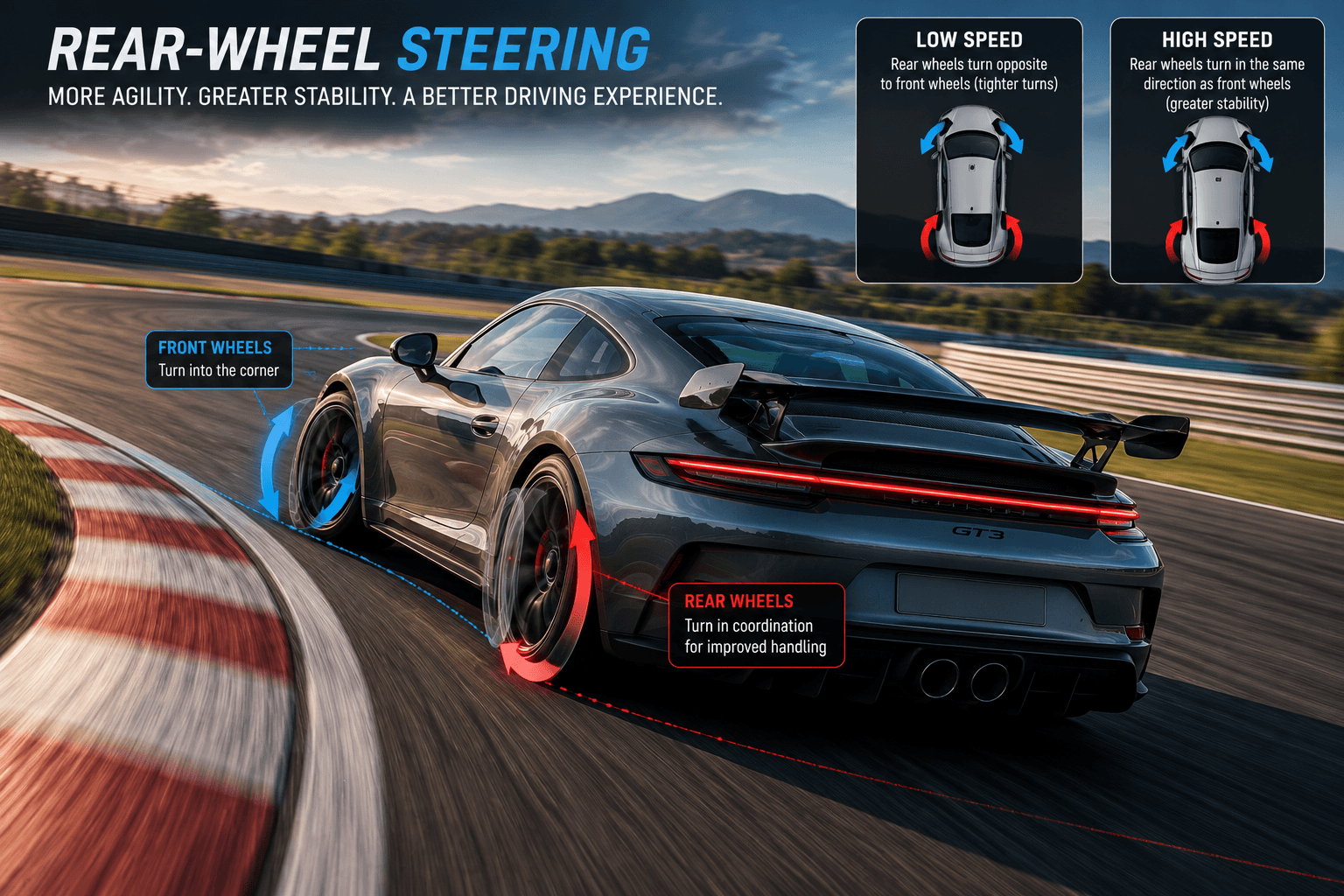
Instead of allowing only the front wheels to determine the vehicle’s direction, a rear-wheel steering system can make small adjustments to the rear wheels. Depending on the vehicle’s speed and driving situation, the rear wheels may turn in the opposite direction from the front wheels or in the same direction.
This seemingly small adjustment can influence the vehicle’s turning radius, agility, stability, and overall steering response. It is especially interesting in modern performance cars because manufacturers are using the technology to balance low-speed maneuverability with high-speed stability.
What Is Rear-Wheel Steering?
Rear-wheel steering is a system that allows the rear wheels to change their steering angle in response to vehicle speed, steering input, and other driving conditions. Unlike conventional steering systems, where the front wheels provide nearly all of the directional control, rear-wheel steering adds another layer of chassis management.
Modern systems are generally electronically controlled. Sensors monitor factors such as vehicle speed, steering angle, yaw rate, and other vehicle dynamics. The control system then determines how much, if any, rear-wheel steering assistance is appropriate.
The amount of rear-wheel movement is usually much smaller than the steering angle at the front. Even a relatively small adjustment can change the way the vehicle responds to steering input.
Rear-axle steering is used on a number of modern performance vehicles. Porsche, for example, describes rear-axle steering on the 911 GT3 RS as a system that increases agility during lower-speed cornering while supporting greater stability at higher speeds. Porsche explains rear-axle steering technology.
Why Do the Rear Wheels Need to Move?
When a vehicle turns, every wheel follows a different path. The front wheels establish the primary direction, while the rear wheels follow the vehicle through the corner.
By making small adjustments at the rear axle, engineers can influence how quickly the vehicle responds to steering input. This can make a long-wheelbase performance car feel more maneuverable without physically shortening the vehicle.
How Rear-Wheel Steering Works at Low Speeds
At lower speeds, rear-wheel steering systems commonly turn the rear wheels in the opposite direction from the front wheels. This is known as counter-phase steering.
Imagine a car entering a tight parking-space maneuver. The front wheels turn toward the corner while the rear wheels make a small movement in the opposite direction. This effectively helps the vehicle rotate around a tighter turning path.
The result can be a smaller turning circle and easier maneuverability in tight spaces. This benefit is particularly useful for larger performance cars that might otherwise feel cumbersome during low-speed maneuvers.
It can also make tight corners on narrow roads easier to navigate. The technology does not eliminate the vehicle’s physical dimensions, but it can change how those dimensions feel from behind the steering wheel.
How Rear-Wheel Steering Works at Higher Speeds
At higher speeds, many rear-wheel steering systems change behavior. Instead of turning the rear wheels opposite to the front wheels, the system may turn them in the same direction.
This is called in-phase steering. The small rear-wheel movement can help stabilize the vehicle during lane changes, high-speed cornering, and rapid directional transitions.
The effect is different from the low-speed behavior. Rather than trying to make the car rotate more quickly, the system is helping produce a more stable response to steering inputs.
Modern performance cars use electronic controls to determine when and how these adjustments occur. The goal is to make the system work without requiring the driver to manually change a setting.
How Rear-Wheel Steering Improves Cornering
Cornering is where rear-wheel steering becomes particularly interesting for sports car enthusiasts. A conventional vehicle relies heavily on front-end steering to establish its path through a corner.
With rear-wheel steering, the rear axle can contribute to the vehicle’s response. At appropriate speeds, the system can help the car rotate into a corner while maintaining a controlled relationship between the front and rear axles.
This can make steering feel more responsive and can help the vehicle follow the driver’s intended line.
Rear-wheel steering does not replace tires or suspension. Instead, it works with these systems as part of the vehicle’s overall chassis design.
For more information about another major factor in sports car handling, read our article on how performance tires affect handling and driving experience.
Rear-Wheel Steering and High-Speed Stability
High-speed stability is another important reason manufacturers use rear-wheel steering. At highway speeds or during fast track driving, sudden steering inputs can produce significant vehicle movement.
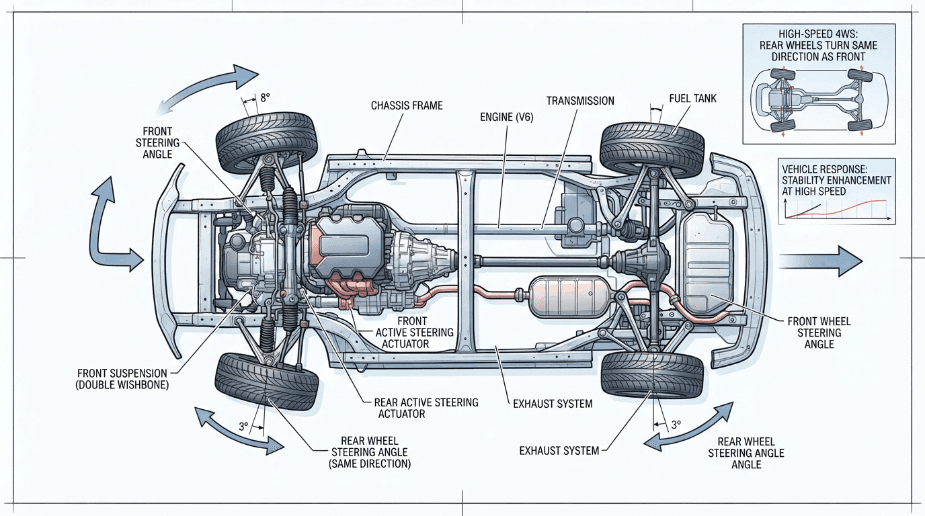
A rear-wheel steering system can coordinate rear-wheel movement with the front wheels to influence the vehicle’s response. When the rear wheels turn slightly in the same direction as the front wheels, the vehicle can respond more smoothly to directional changes.
This can be useful during rapid lane changes and high-speed corners. The technology is particularly relevant to performance cars because these vehicles can reach speeds where small chassis responses become more noticeable.
Rear-Wheel Steering and Track Performance
On a racetrack, steering response is critical. Drivers repeatedly transition between braking, corner entry, apexes, acceleration, and straight-line sections.
Rear-wheel steering can influence how a performance car transitions between these phases. During lower-speed corners, counter-phase rear steering can help the vehicle rotate. During faster sections, in-phase steering can contribute to stability.
The system therefore provides different characteristics depending on the situation rather than relying on one fixed steering behavior.
Drivers preparing their vehicles for track use can also explore our guide to 2026 track-day upgrades.
Rear-Wheel Steering vs Traditional Steering
A traditional two-wheel steering system is mechanically simpler. Only the front wheels are actively steered, while the rear wheels remain aligned with the vehicle chassis.
This arrangement has been successful for decades and remains common across the automotive industry.
Rear-wheel steering adds additional hardware, sensors, actuators, and control software. In return, it provides engineers with another method of influencing vehicle dynamics.
The trade-off is increased complexity. Additional components can add weight and may require specialized maintenance if problems develop.
How Rear-Wheel Steering Changes Steering Feel
One of the most noticeable effects of rear-wheel steering can be the way a vehicle responds to steering input. A car equipped with the system may feel more agile during tight corners while remaining composed during faster directional changes.
Some drivers may notice that the vehicle seems to rotate more naturally than expected. Others may notice the effect primarily during parking or low-speed maneuvers.
The exact sensation depends on the vehicle’s wheelbase, steering ratio, suspension calibration, tire characteristics, rear-steering angle, and software tuning.
Rear-Wheel Steering and Suspension Technology
Rear-wheel steering does not operate independently from the suspension. Modern performance cars are designed as integrated systems in which steering, damping, springs, tires, brakes, and electronic controls work together.
Changing one aspect of the chassis can influence the behavior of another. For example, a suspension setup determines how the tires maintain contact with the road while rear-wheel steering changes the direction of the rear axle.
Our guide on suspension upgrades for performance sports cars provides additional information about the relationship between suspension setup and handling.
Does Rear-Wheel Steering Make a Sports Car Faster?
Rear-wheel steering should not be viewed simply as a device for increasing top speed. Its primary purpose is to influence vehicle dynamics.
Depending on the vehicle and conditions, the technology can help a car respond more effectively to steering inputs and maintain stability during directional changes.
Any effect on lap times depends on the complete vehicle, driver, tires, track layout, and calibration of the chassis systems.
Potential Drawbacks of Rear-Wheel Steering
Advanced steering technology also introduces additional complexity. A rear-wheel steering system requires actuators, sensors, electronic controls, and mechanical components that are not necessary on a conventional steering system.
These components can add weight and manufacturing cost. Repairs may also require specialized diagnostic equipment and technicians familiar with the particular system.
For drivers considering a performance vehicle, these factors can be worth considering alongside the handling benefits and driving characteristics.
Rear-Wheel Steering in Modern Performance Cars
Rear-wheel steering continues to appear in high-performance vehicles as manufacturers search for ways to combine agility, stability, and everyday usability.
For example, Porsche’s current 911 Turbo S incorporates rear-axle steering alongside other chassis technologies. Porsche states that rear-axle steering reduces the turning circle at lower speeds while supporting stability at higher speeds.
The technology also appears in other performance and luxury vehicles, demonstrating that rear-wheel steering is no longer limited to specialized motorsport applications.
As performance cars become more electronically controlled, rear-wheel steering is increasingly being integrated with other vehicle systems rather than functioning as an isolated feature.
Is Rear-Wheel Steering Worth Considering When Buying a Sports Car?
For someone shopping for a performance vehicle, rear-wheel steering can be an interesting feature to evaluate during a test drive. The important consideration is not simply whether the vehicle has the technology but how it has been calibrated.
Drivers should pay attention to low-speed maneuverability, steering response, cornering behavior, lane changes, and the overall relationship between steering input and vehicle movement.
The feature can be especially relevant when comparing larger performance cars that need to balance everyday maneuverability with high-speed capability.
For more guidance when evaluating different vehicles, visit the Car Buying Advice section of AutosportReviews.
Final Thoughts
Rear-wheel steering is an example of how modern sports car engineering goes beyond adding horsepower. By allowing the rear wheels to make small steering adjustments, manufacturers can influence how a vehicle behaves at different speeds.
At lower speeds, opposite-phase steering can help reduce the turning radius and improve maneuverability. At higher speeds, same-phase steering can support stability during directional changes and fast cornering.
The technology works alongside tires, suspension, brakes, aerodynamics, and electronic vehicle controls. It does not replace these systems but adds another tool for engineers to use when developing a performance car.
For enthusiasts, understanding rear-wheel steering provides another way to appreciate the engineering behind modern sports cars. As manufacturers continue developing electronically controlled chassis systems, technologies such as rear-axle steering will remain an important part of the conversation about handling, agility, and the evolving sports car driving experience.