
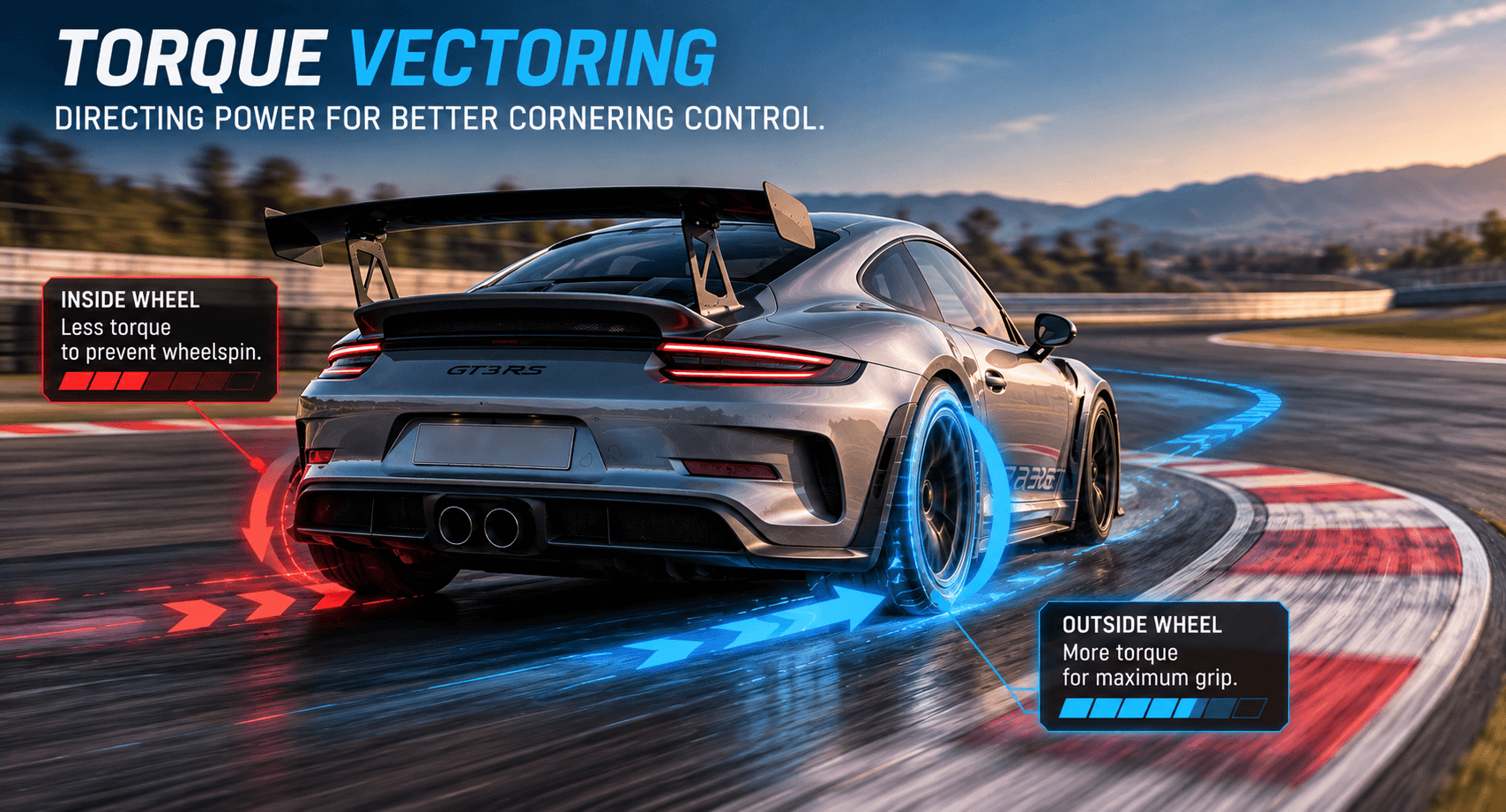
Modern sports cars use far more technology to manage performance than simply adding horsepower. As engines become more powerful and vehicles become faster, manufacturers need sophisticated systems to help drivers control that performance through corners. One of the technologies used for this purpose is torque vectoring.
Torque vectoring can influence how much driving force is delivered to individual wheels during acceleration and cornering. By managing torque distribution, the system can help a performance car respond more precisely to steering inputs while improving traction and stability.
Although torque vectoring is sometimes discussed alongside limited-slip differentials, the two technologies are not exactly the same. A limited-slip differential primarily limits the speed difference between driven wheels, while torque-vectoring systems can actively influence how torque is distributed to help the vehicle follow the driver’s intended path.
What Is Torque Vectoring?
Torque vectoring is a vehicle-dynamics technology that manages the distribution of driving force between wheels or axles. The system uses information from sensors to determine what the vehicle is doing and can then adjust torque delivery accordingly.
Depending on the vehicle, torque vectoring can be achieved through mechanical differential systems, electronically controlled clutches, electric motors, or targeted braking interventions.
Porsche describes torque vectoring as a technology that varies the amount of power sent to driven wheels to improve agility and control through corners. Its systems can monitor steering angle, vehicle speed, wheel speed, and yaw rate to determine how torque should be adjusted. Learn more about torque vectoring from Porsche.
Why Torque Distribution Matters
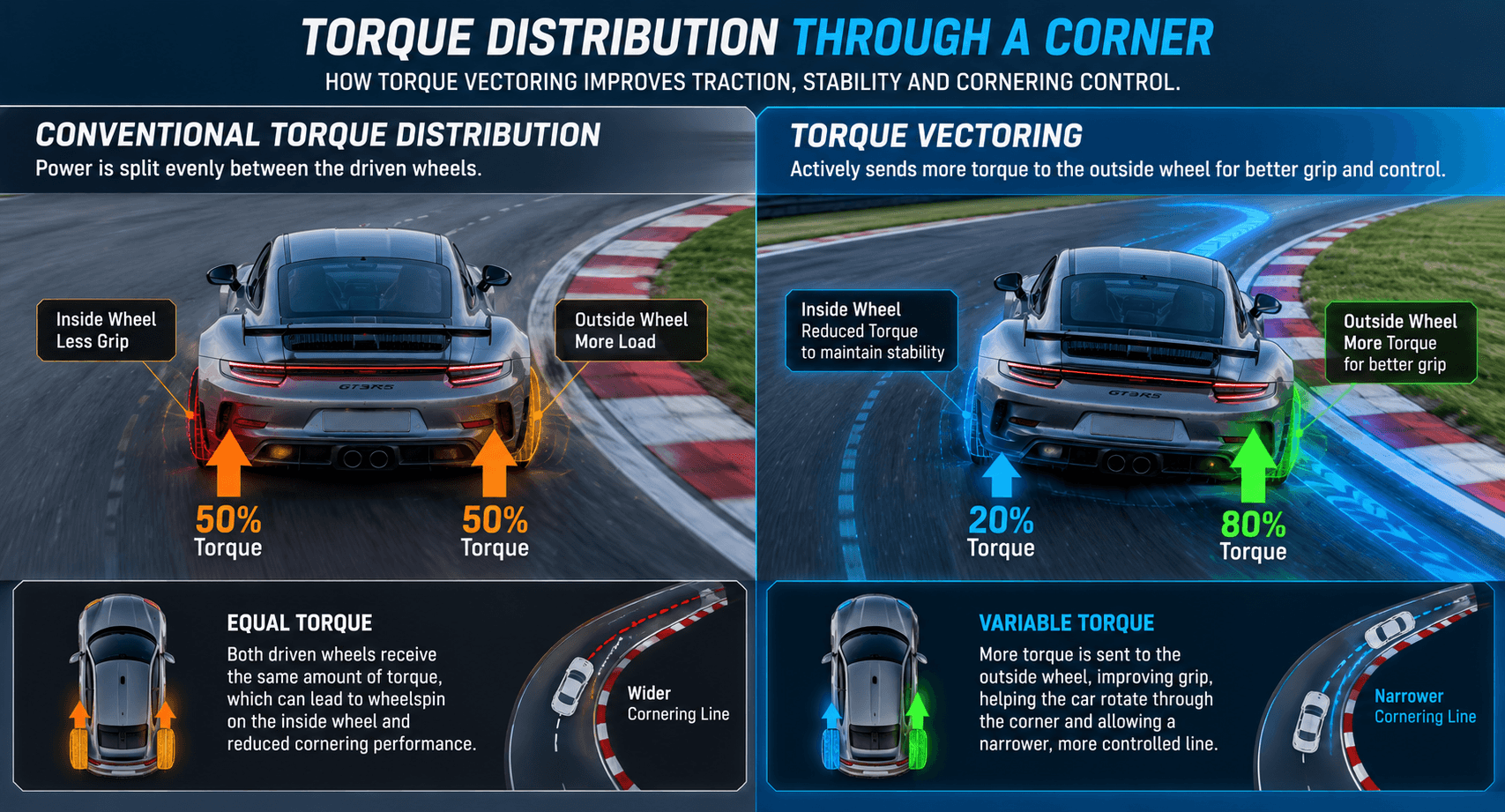
When a car travels through a corner, the tires do not all experience the same amount of load or available grip. The outside tires generally carry more load while the inside tires can have less available traction.
If power is applied without considering these differences, one of the driven tires may begin to spin or the vehicle may not rotate through the corner as effectively as intended.
Torque vectoring gives engineers another way to manage these differences and influence the vehicle’s response.
How Torque Vectoring Works During Cornering
Imagine a rear-wheel-drive sports car entering a right-hand corner. As the driver turns the steering wheel and applies throttle, the vehicle’s weight shifts and the rear tires experience different levels of grip.
A torque-vectoring system can detect the vehicle’s steering angle, wheel speeds, and rotational movement. It can then adjust torque distribution to help the vehicle follow the desired cornering path.
Some systems increase torque delivered to the outside driven wheel. Others use targeted braking on an inside wheel to create a yaw effect that helps the vehicle rotate.
The exact strategy depends on the vehicle’s hardware and software calibration.
Torque Vectoring vs Limited-Slip Differentials
Torque vectoring and limited-slip differentials are closely related technologies, but they perform different functions.
A limited-slip differential is designed to limit excessive speed differences between the driven wheels. When one wheel begins to spin, the differential can help transfer more usable torque to the wheel with greater available grip.
Torque vectoring can take this concept further by deliberately changing torque distribution to influence vehicle rotation and cornering behavior.
Our guide on limited-slip differentials and sports car traction explains the role of the differential in more detail.
Mechanical Torque Vectoring
Mechanical torque-vectoring systems can use specialized differentials and clutch mechanisms to vary torque distribution between the driven wheels.
These systems can provide a direct mechanical response and are commonly associated with high-performance applications.
Brake-Based Torque Vectoring
Another approach uses the braking system to influence torque distribution. The system can apply a small amount of braking force to an inside driven wheel while allowing more usable drive force to reach the outside wheel.
This approach can be integrated with electronic stability and traction systems without requiring an extremely complex differential.
Porsche explains that some torque-vectoring systems use targeted braking on an inside wheel to influence the vehicle’s yaw and help it follow the intended line through a bend.
How Torque Vectoring Improves Cornering
One of the primary benefits of torque vectoring is improved cornering response. When the system detects that the vehicle needs additional rotation, it can adjust torque distribution to influence the car’s movement.
This can help reduce unwanted understeer, where the vehicle does not turn as much as the driver requests. By managing torque more precisely, the system can help the vehicle rotate toward the corner.
The technology can also help manage oversteer by controlling the amount of driving force reaching the rear wheels.
The goal is not simply to make the vehicle turn more aggressively. The system is designed to help maintain a predictable relationship between steering input, throttle application, and vehicle movement.
Torque Vectoring and Acceleration Out of Corners
Corner exit is another situation where torque vectoring can be useful. Once a sports car reaches the apex of a corner, the driver begins applying more throttle.
At this point, traction becomes extremely important. Too much torque at a tire with limited grip can produce wheelspin, while poor torque distribution can reduce the vehicle’s ability to accelerate efficiently.
Torque vectoring can help manage the available grip by adjusting how driving force is distributed. This can help the car transition from cornering to acceleration more smoothly.
For another look at how tire grip influences performance, read our article on performance tires and sports car handling.
How Sensors Help Torque Vectoring Work
Modern torque-vectoring systems depend heavily on electronic sensors. The vehicle continuously collects information about what the driver is doing and how the car is responding.
Important information can include steering angle, individual wheel speeds, vehicle speed, acceleration, yaw rate, throttle position, and drivetrain conditions.
The control software processes this information and determines whether torque distribution should be adjusted.
Because these calculations happen rapidly, the driver may not notice the individual interventions. Instead, the driver experiences the combined effect as improved stability, traction, or cornering response.
Torque Vectoring and All-Wheel Drive
Torque vectoring can be particularly useful in all-wheel-drive performance cars. An all-wheel-drive system already has the ability to send power to multiple axles, but torque vectoring can add another level of control.
Depending on the design, the system may vary torque between the front and rear axles or between individual wheels.
This allows manufacturers to develop different handling characteristics. A vehicle can be calibrated to prioritize stability, agility, traction, or a particular balance between these characteristics.
Modern performance vehicles increasingly combine torque vectoring with other electronic chassis systems to create a coordinated approach to vehicle dynamics.
Torque Vectoring in Electric Performance Cars
Electric vehicles create new opportunities for torque vectoring because individual electric motors can be controlled electronically.
A vehicle with separate motors for different axles or individual wheels can adjust torque extremely quickly. Instead of relying entirely on mechanical components, software can control motor output according to driving conditions.
This can give electric performance vehicles highly precise control over torque distribution.
Bosch notes that integrated vehicle-dynamics systems can coordinate traction and stability functions to adapt sports-car behavior to different conditions. Explore Bosch’s performance and vehicle-dynamics technology.
Torque Vectoring and Suspension Setup
Torque vectoring does not operate independently of the chassis. Suspension, tires, steering, brakes, and drivetrain systems all influence how effectively the technology can work.
A vehicle needs consistent tire contact with the road for torque-vectoring interventions to produce predictable results. Suspension tuning therefore remains an important part of the overall performance equation.
Our article on suspension upgrades for performance sports cars provides additional information about how suspension changes influence handling.
Torque Vectoring and Rear-Wheel Steering
Modern performance vehicles may combine torque vectoring with rear-wheel steering. These systems influence different aspects of vehicle behavior but can work together to improve the overall response.
Rear-wheel steering changes the direction of the rear axle, while torque vectoring changes the distribution of driving force. Combining the two gives engineers additional tools for managing corner entry, mid-corner behavior, and acceleration.
For more information, see our article on rear-wheel steering in sports cars.
Is Torque Vectoring Only Useful on a Racetrack?
Torque vectoring is particularly noticeable during spirited driving and track use, but the technology can also operate during normal road driving.
On wet or uneven surfaces, differences in tire grip can become more significant. Electronic drivetrain and stability systems can respond to these changes to help maintain predictable vehicle behavior.
However, drivers should not assume that electronic systems can overcome the physical limitations of tires or road conditions. Available grip remains fundamental to vehicle control.
Potential Limitations of Torque Vectoring
Advanced torque-vectoring systems can add complexity, cost, weight, and maintenance requirements. Mechanical systems may require specialized components, while electronically controlled systems rely on sensors, actuators, and software.
Brake-based torque vectoring can also place additional demands on the braking system because targeted brake interventions are part of the system’s operation.
This is one reason performance vehicles are engineered as complete systems rather than collections of unrelated upgrades.
Torque Vectoring for Track-Day Performance
Torque vectoring can be valuable during track driving because a circuit repeatedly demands changes in direction, braking, acceleration, and power application.
During a lap, the system may help the car transition from corner entry to apex and then toward corner exit. Its contribution depends on the vehicle’s calibration and the driver’s inputs.
It should be considered alongside tires, brakes, suspension, cooling, and driver technique rather than as a standalone performance solution.
For additional track preparation information, check out our guide to 2026 track-day upgrades.
What Should Sports Car Buyers Know?
For someone shopping for a performance vehicle, torque vectoring can be an interesting feature to investigate. Buyers should look beyond the name of the system and learn how the particular manufacturer implements it.
Some systems use mechanical differentials, while others rely on electronically controlled clutches or brake intervention. Electric vehicles may use individual motors to achieve similar objectives.
During a test drive, drivers can pay attention to steering response, cornering behavior, throttle response, and how the car transitions from braking to acceleration.
For additional vehicle-selection guidance, visit the Car Buying Advice section of AutosportReviews.
Final Thoughts
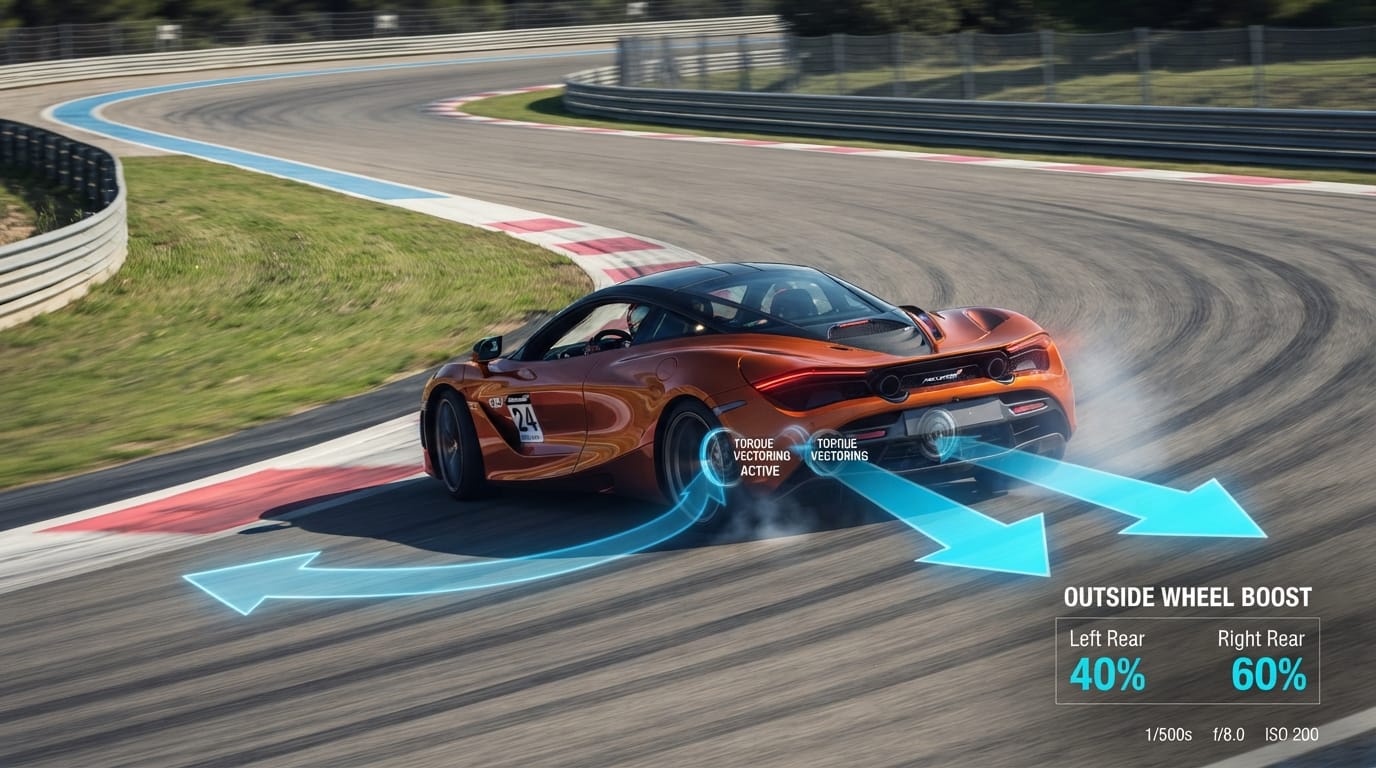
Torque vectoring is an important example of how modern sports cars use electronics and mechanical systems together to manage performance. By adjusting how driving force reaches the wheels, the technology can influence traction, cornering response, stability, and acceleration.
Unlike a simple power increase, torque vectoring focuses on how effectively a vehicle uses the power it already has. That makes it particularly relevant as modern sports cars become faster and more powerful.
The technology is also evolving. Mechanical systems, brake-based systems, electronically controlled differentials, and electric motors can all be used to influence torque distribution. As electrification expands, manufacturers have even more opportunities to control torque precisely.
For sports car enthusiasts, understanding torque vectoring provides another look at what happens beneath the surface when a performance car enters a corner. The engine may provide the power, but systems such as torque vectoring help determine how effectively that power can be converted into controlled movement.