
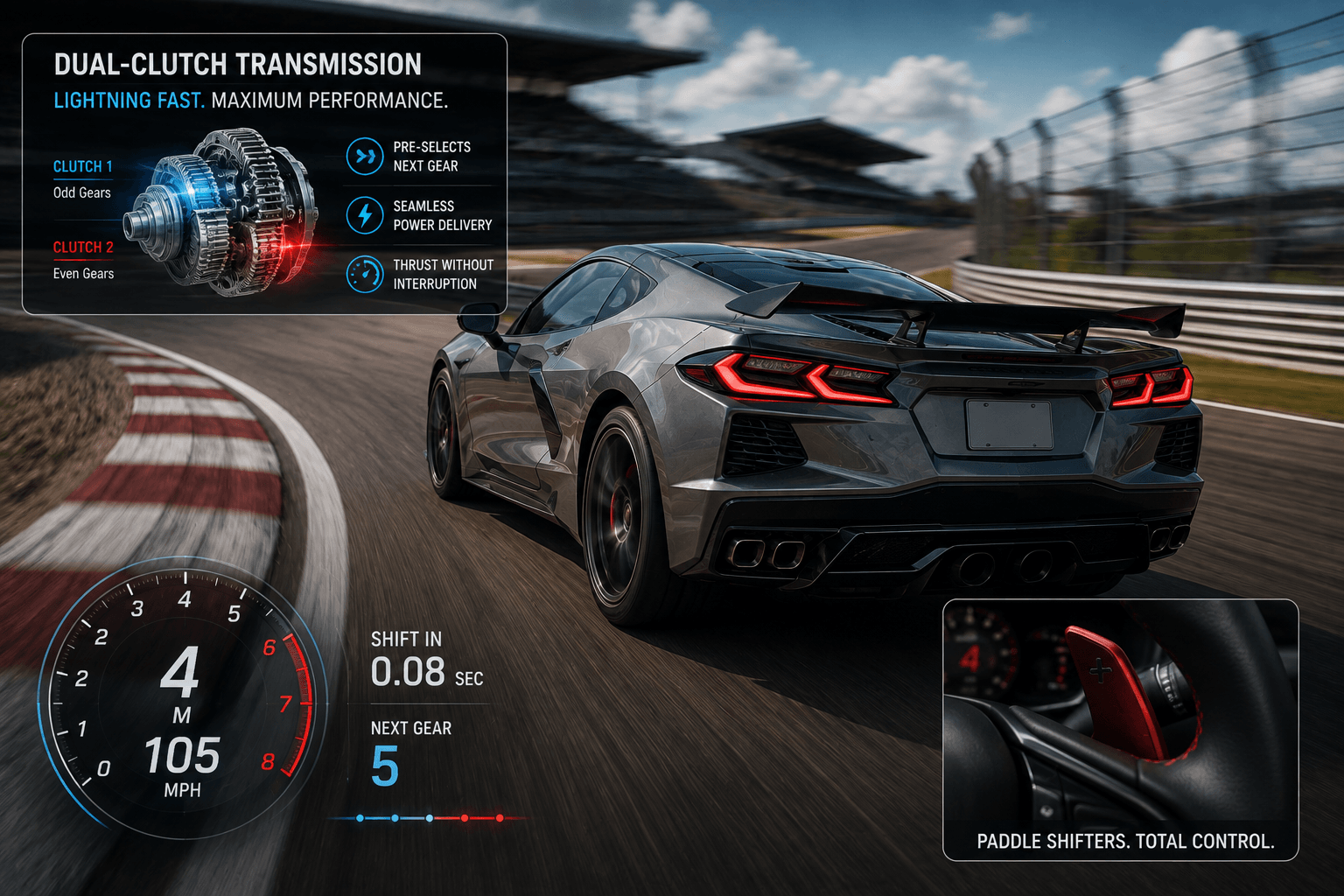
Transmission technology has become one of the defining characteristics of modern sports cars. While engine power, tires, brakes, and suspension receive plenty of attention, the transmission determines how effectively that power reaches the wheels. For many performance vehicles, the dual-clutch transmission has become an important part of delivering rapid acceleration and precise gear changes.
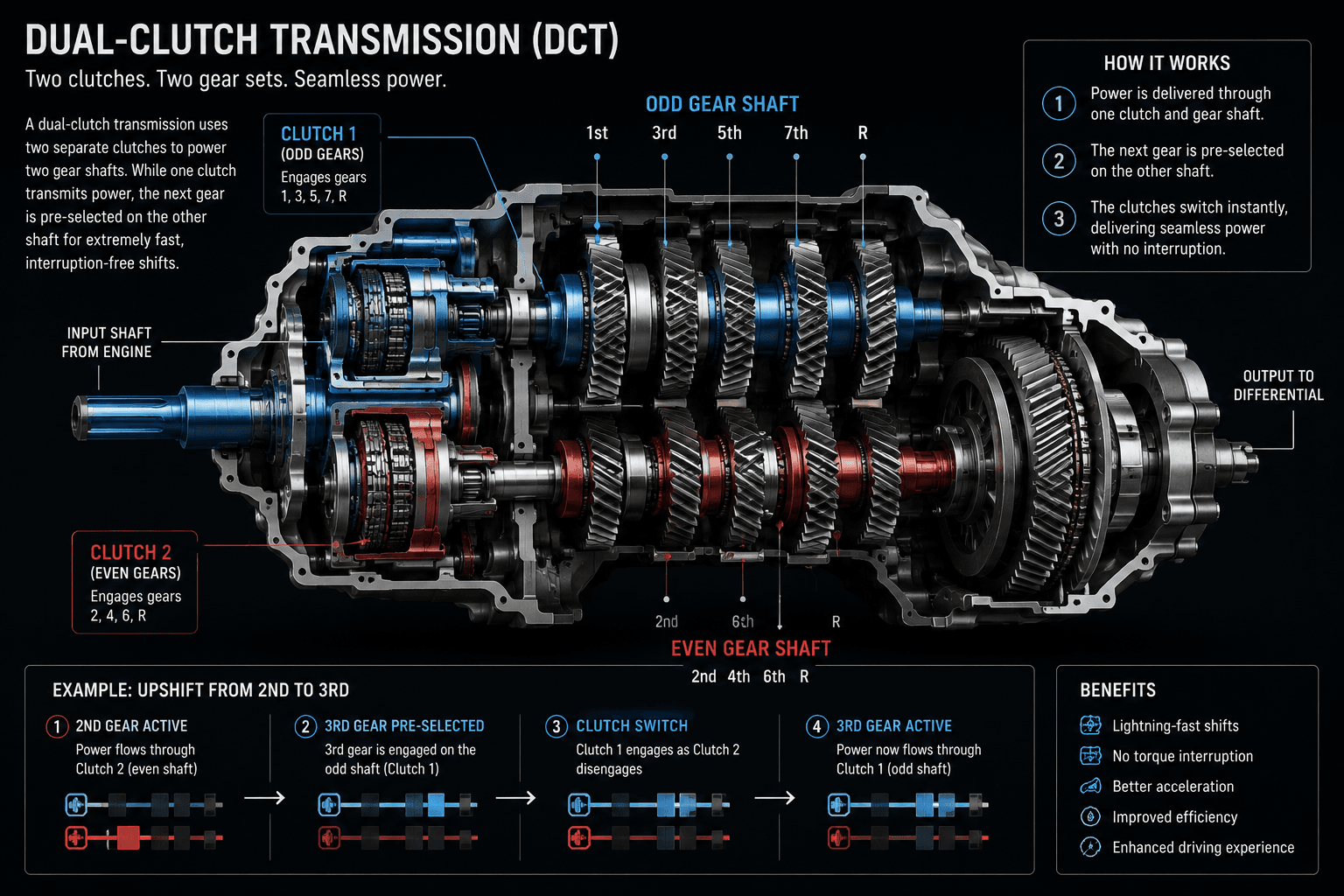
A dual-clutch transmission, commonly called a DCT, combines elements of a manual gearbox with computer-controlled shifting. Instead of using one clutch for all gears, a DCT uses two separate clutches. One clutch generally manages odd-numbered gears while the other manages even-numbered gears. This allows the next gear to be prepared before the current gear is released.
The result can be exceptionally quick gear changes with minimal interruption of power. ZF describes its dual-clutch technology as allowing gear changes under load without interrupting thrust, making the system particularly suitable for sporty vehicles. Learn more about ZF dual-clutch transmission technology.
What Is a Dual-Clutch Transmission?
A dual-clutch transmission is an automated gearbox that uses two clutches to manage different groups of gears. Instead of relying on one clutch to disconnect the engine from the transmission every time the vehicle shifts, the two-clutch arrangement allows the transmission to prepare the upcoming gear while the vehicle is still accelerating.
In a typical arrangement, one clutch controls odd gears while the other controls even gears. If the vehicle is traveling in third gear, for example, fourth gear can already be selected internally. When the transmission determines that a shift is appropriate, control can transfer from one clutch to the other.
This design is one reason modern DCTs can deliver extremely fast shifts. Bosch notes that in a DCT, gears can already be engaged before the shift occurs, allowing shift speeds beyond what a driver can generally achieve manually. Bosch explains modern automatic transmission technology.
Why Two Clutches Matter
The two-clutch arrangement is important because it reduces the amount of time required to change gears. With a traditional manual transmission, the driver must release the accelerator or manage engine speed, disengage the clutch, select another gear, and reconnect the clutch.
A conventional automatic transmission uses a different mechanism, commonly involving a torque converter and planetary gearsets. A DCT instead relies on its two-clutch architecture and electronic control systems to coordinate gear selection and clutch engagement.
How DCTs Improve Acceleration
One of the biggest advantages of a dual-clutch transmission is its ability to maintain strong acceleration during gear changes. When the transmission shifts quickly, the engine spends less time disconnected from the wheels.
This can make acceleration feel smooth and continuous. Instead of a noticeable pause between gears, the driver may experience a rapid transition that keeps the vehicle moving forward with minimal interruption.
This characteristic is particularly useful in high-performance cars. When a powerful engine is producing significant torque, fast gear changes can help keep the engine within its effective power range.
For enthusiasts interested in how engine output and transmission behavior work together, our article on engine tuning for sports cars provides a useful related resource.
DCTs and Paddle-Shift Driving
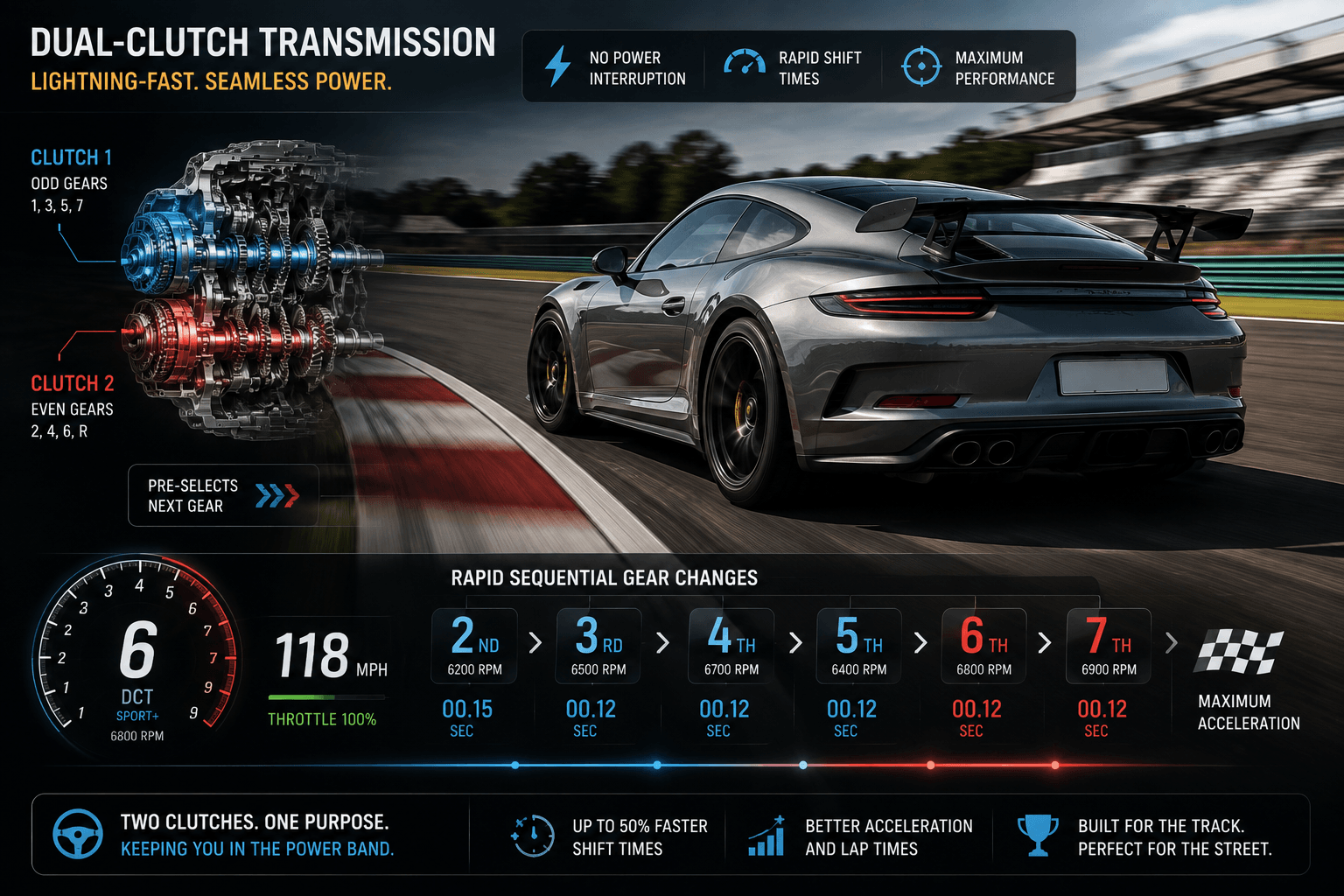
Many sports cars equipped with dual-clutch transmissions feature steering-wheel-mounted paddle shifters. These allow the driver to request an upshift or downshift without removing their hands from the steering wheel.
When combined with a DCT, paddle shifters can provide a highly responsive driving experience. The driver can select gears manually while the transmission computer manages clutch operation and protects the drivetrain from certain inappropriate inputs.
This creates an interesting balance between manual involvement and automated control. Drivers can choose their preferred gear during spirited driving while still benefiting from the speed and consistency of computer-controlled clutch operation.
Automatic Mode vs Manual Mode
One advantage of modern DCT systems is flexibility. In automatic mode, the transmission can select gears based on vehicle speed, throttle position, engine load, and the selected driving mode.
In manual mode, the driver can request gear changes through the paddles. Depending on the vehicle, the transmission may hold the selected gear longer, downshift during braking, or automatically protect the engine from excessive rpm.
How DCTs Change Cornering Behavior
Transmission behavior can influence how a sports car feels through corners. Choosing the correct gear before entering a turn helps keep the engine ready to accelerate when the vehicle reaches the corner exit.
A fast downshift can also help place the engine in a more useful rpm range. Once the car begins accelerating out of the corner, the transmission can quickly move through the gears while maintaining strong power delivery.
This is particularly useful during track driving, where gear selection and acceleration timing can affect the overall rhythm of a lap.
Transmission performance works alongside other systems. For example, our guide to limited slip differentials explains how drivetrain technology helps manage power at the driven wheels.
DCTs Compared With Manual Transmissions
Manual transmissions remain popular because they provide direct driver involvement. The driver controls the clutch, gear selection, and engine speed. This creates a mechanical connection that many enthusiasts find rewarding.
A DCT offers a different experience. It can automate the clutch operation while delivering very fast gear changes. This can make the car easier to drive quickly, particularly during repeated acceleration and braking.
The choice ultimately depends on what the driver values. Someone looking for maximum involvement may prefer a manual. Someone prioritizing rapid shifts and consistency may prefer a DCT.
DCTs Compared With Traditional Automatic Transmissions
Traditional automatic transmissions have also evolved significantly. Modern torque-converter automatics can provide fast, smooth shifts and excellent efficiency. Some are capable of competing closely with DCTs in everyday driving and performance applications.
Car and Driver has discussed how modern automatic transmissions can challenge dual-clutch gearboxes in areas such as shift quality and overall versatility. Read Car and Driver’s analysis of modern automatic transmission technology.
Because transmission design continues to improve, buyers should evaluate the complete vehicle rather than assuming that one transmission type is automatically superior.
Wet vs Dry Dual-Clutch Systems
Dual-clutch systems can use either wet or dry clutch designs. The distinction relates to how the clutch components are cooled and lubricated.
Wet clutches operate with fluid around the clutch components. This can help with heat management and may make them suitable for applications involving higher torque or demanding operating conditions.
Dry clutches do not operate immersed in transmission fluid. They can have efficiency and packaging advantages, but their behavior and thermal characteristics differ from wet-clutch systems.
Why Heat Management Matters
Performance driving creates additional thermal demands throughout the drivetrain. Repeated acceleration, braking, and gear changes can increase transmission temperatures.
This is one reason proper maintenance and manufacturer-recommended fluid service are important for DCT-equipped vehicles. A high-performance transmission still depends on correct lubrication, cooling, and calibration.
Are Dual-Clutch Transmissions Good for Daily Driving?
A modern DCT can be very comfortable during normal driving. In automatic mode, the transmission can select gears without requiring driver input, making it convenient for commuting and highway driving.
However, some DCTs can feel different from conventional automatic transmissions at very low speeds. Maneuvering in parking lots, crawling through traffic, or starting from a stop may produce a different sensation because the transmission is managing clutch engagement.
This does not necessarily mean the transmission is performing poorly. It is simply a characteristic drivers should understand when evaluating a vehicle.
Maintenance Considerations for DCT Vehicles
Maintenance requirements vary by manufacturer and transmission design. Owners should follow the service schedule specified for their particular vehicle.
Transmission fluid condition can be important, particularly for systems that use wet clutches. Fluid changes, inspections, software updates, and diagnostic checks may all be part of maintaining a modern performance transmission.
Ignoring recommended maintenance can increase the risk of premature wear and drivability problems. A performance-oriented drivetrain still needs routine care.
How DCT Technology Is Evolving
Dual-clutch transmissions continue to evolve alongside hybrid and electrified powertrains. Manufacturers and suppliers are developing transmission systems that combine fast shifting with improved efficiency and hybrid functionality.
ZF, for example, has developed dual-clutch systems designed for rear-wheel-drive, all-wheel-drive, and hybrid applications. Its technology demonstrates how transmission systems are increasingly being designed as part of a larger powertrain rather than as isolated components. Explore ZF’s dual-clutch transmission technology.
This development is particularly important as performance vehicles become more electrified. Electric motors can provide instant torque while advanced transmissions continue managing combustion-engine power and vehicle efficiency.
What Should Sports Car Buyers Look For?
When shopping for a performance car with a DCT, the transmission should be evaluated as part of the entire vehicle. Look at shift quality, responsiveness, maintenance requirements, driving modes, and how the transmission behaves during both aggressive and relaxed driving.
It is also worth considering whether the vehicle will primarily be used for commuting, weekend driving, or track events. A transmission calibration that feels exciting on a circuit may not necessarily provide the same experience in heavy traffic.
For additional guidance when comparing performance vehicles, visit our Car Buying Advice category.
Final Thoughts
Dual-clutch transmissions have changed the way many modern sports cars deliver performance. Their two-clutch architecture allows the next gear to be prepared in advance, helping produce rapid shifts and strong acceleration.
For performance drivers, the combination of paddle-shift control, quick gear changes, and automated clutch management can create an engaging experience without requiring the driver to operate a traditional clutch pedal.
At the same time, DCT technology is not automatically better for every driver. Manual transmissions offer greater mechanical involvement, while modern torque-converter automatics can provide exceptional smoothness and performance. The best choice depends on the vehicle, driving style, and priorities.
As automotive technology continues to evolve, transmissions will remain an important part of how performance cars feel. Whether the goal is faster acceleration, smoother shifting, or greater efficiency, the gearbox plays a critical role in turning engine power into an enjoyable driving experience.
For readers interested in preparing a performance car for more demanding driving, our guide to 2026 track-day upgrades provides another useful starting point.