

Wheels are one of the most important components on a sports car because they connect the vehicle to its tires, brakes, suspension, and the road. While many performance enthusiasts focus on engine power or aerodynamic upgrades, wheel design can have a significant influence on how a car accelerates, brakes, corners, and responds to steering inputs.
Carbon fiber wheels have emerged as one of the most advanced wheel technologies available for performance vehicles. Their primary attraction is their ability to reduce weight while maintaining the strength and stiffness required for demanding automotive applications.
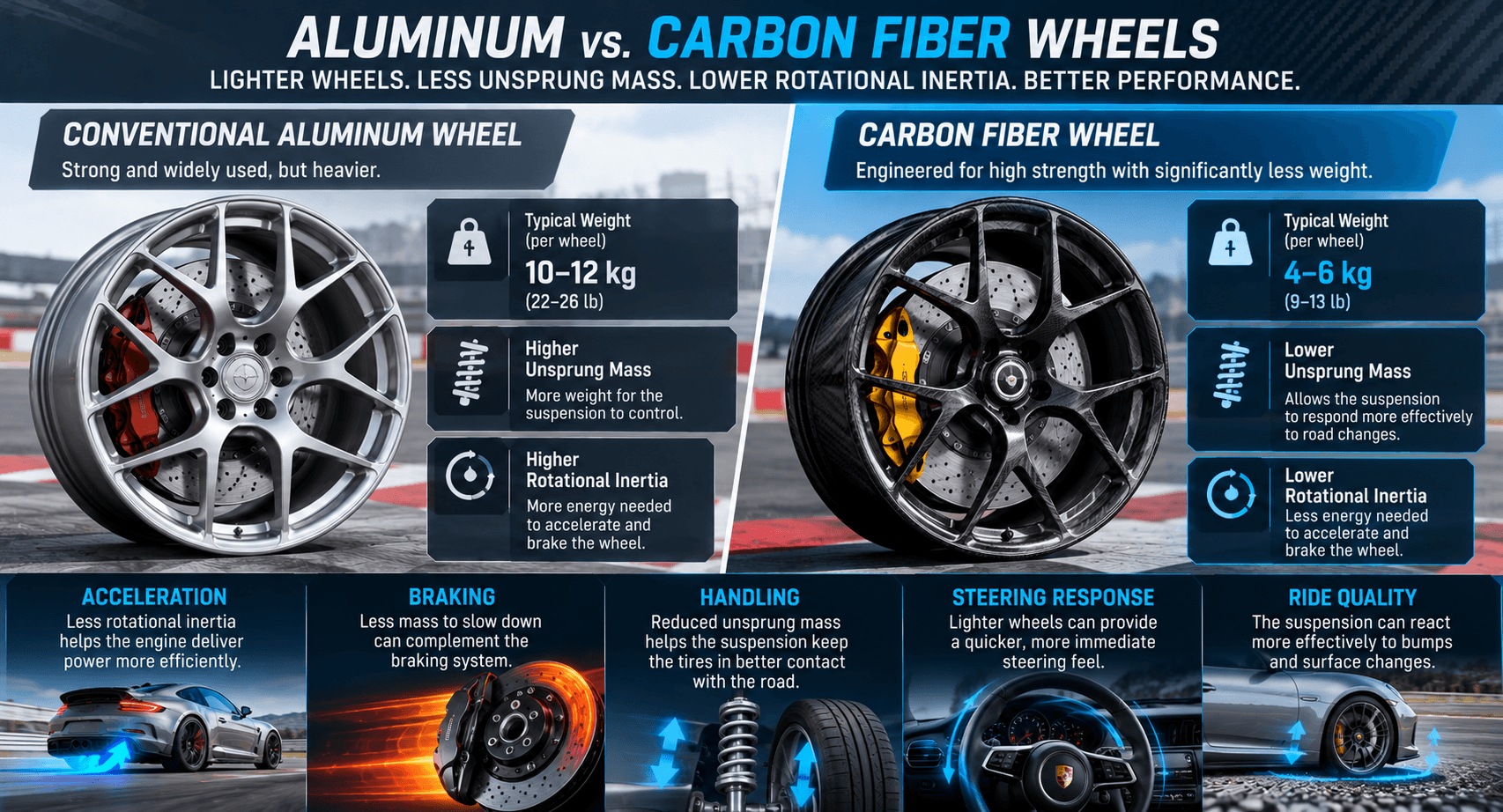
For a sports car, reducing weight at the wheels can have different effects from removing an equivalent amount of weight from the vehicle’s interior or body. Wheels are unsprung components, and they also rotate. This means reducing wheel mass can influence suspension behavior and rotational inertia in addition to reducing overall vehicle weight.
That combination makes carbon fiber wheels particularly interesting for drivers who want sharper handling without relying entirely on additional horsepower.
What Are Carbon Fiber Wheels?
Carbon fiber wheels are wheels manufactured primarily from carbon fiber-reinforced composite materials rather than conventional aluminum or steel. Carbon fiber combines high strength and stiffness with relatively low mass, allowing engineers to design lightweight structures for demanding applications.
Modern carbon fiber wheels are engineered products rather than simple cosmetic accessories. Manufacturers have to consider impact resistance, fatigue, heat exposure, stiffness, vibration, mounting requirements, and long-term durability.
Carbon Revolution, a major automotive carbon-fiber wheel manufacturer, explains that its wheels are engineered and tested for applications ranging from everyday road use to motorsport. Learn more about carbon fiber wheel technology.
How Carbon Fiber Differs From Aluminum
Aluminum has been a popular wheel material for decades because it offers a strong combination of weight, durability, cost, and manufacturability. Forged aluminum wheels can already be extremely lightweight and strong.
Carbon fiber takes the lightweight approach further by allowing engineers to optimize the material’s placement and structural properties. The result can be a wheel that is substantially lighter than an equivalent aluminum design.
However, carbon fiber wheels are generally more expensive and require specialized manufacturing and validation. The performance benefits therefore need to be considered alongside their cost.
Why Wheel Weight Matters
Wheel weight matters for two major reasons. First, wheels contribute to the overall mass of the vehicle. Second, wheels are part of the vehicle’s unsprung and rotating mass.
Unsprung mass includes components that are not supported directly by the vehicle’s springs. Wheels, tires, and portions of the suspension and braking system fall into this category.
Reducing unsprung mass can allow the suspension to respond more effectively to changes in the road surface. This can help the tire maintain contact with the pavement and potentially improve ride quality and handling.
For more information about the broader relationship between vehicle mass and performance, see our article on weight reduction and sports car performance.
Rotational Inertia Also Matters
Wheels do not simply move with the vehicle. They rotate as the car accelerates, brakes, and changes direction.
Reducing mass in a rotating component can reduce the amount of energy required to accelerate and decelerate that component. This is one reason lightweight wheels can provide benefits that extend beyond their contribution to the vehicle’s static weight.
The exact effect depends on the wheel’s mass distribution, diameter, construction, and overall vehicle configuration.
How Carbon Fiber Wheels Affect Acceleration
Acceleration is one area where lightweight wheels can provide a noticeable benefit. A vehicle has to accelerate both its overall mass and the rotating components attached to it.
Reducing wheel weight can decrease the energy required to accelerate the wheels. This can contribute to a more responsive powertrain and may complement engine and transmission improvements.
The difference may be more noticeable during repeated acceleration than during a single gentle launch. Performance drivers often value this responsiveness because it can make the vehicle feel more eager when the throttle is applied.
Carbon Revolution states that reducing wheel mass can improve acceleration, braking, and handling through reductions in unsprung and rotational mass. Explore Carbon Revolution’s wheel technology and applications.
How Carbon Fiber Wheels Affect Braking
The same rotating-mass principle applies during braking. The braking system must slow the vehicle and its rotating wheels from speed.
Reducing wheel mass can reduce the rotational energy that must be dissipated during deceleration. This can complement the work performed by the brake rotors, pads, and calipers.
However, lightweight wheels do not automatically transform a vehicle’s braking distance. Tire grip, brake components, road conditions, vehicle speed, and electronic brake systems remain critical factors.
For a broader look at braking performance, read our article on performance brake upgrades.
How Carbon Fiber Wheels Affect Handling
Handling is arguably one of the most important reasons performance enthusiasts consider lightweight wheels.
Because wheels are part of the unsprung mass, reducing their weight can help the suspension react to bumps, surface changes, and curbing. A lighter wheel can require less force for the suspension to control its movement.
This can contribute to more consistent tire contact with the road and a more responsive feel through corners.
For a sports car, these improvements can be particularly useful because cornering performance depends heavily on how consistently the tires remain connected to the road surface.
Steering Response
Lightweight wheels can also influence steering response. Reducing mass at the front axle can help the steering system respond more quickly to driver inputs.
The result may be a lighter and more immediate steering feel, although the exact sensation depends on the vehicle’s steering system, wheel size, tire construction, alignment, and suspension setup.
Our guide on suspension upgrades for sports car handling provides additional context on how wheel and suspension behavior work together.
Carbon Fiber Wheels and Tire Performance
Wheels and tires should be considered as a complete package. Installing a lightweight wheel does not automatically improve grip if the tire is poorly suited to the vehicle or driving conditions.
The tire remains the primary contact point between the car and road. Wheel diameter, width, offset, tire construction, compound, and pressure all influence how the package performs.
Lightweight wheels can therefore be most effective when matched with appropriate performance tires.
For more information, read our guide on how performance tires affect handling, speed, and driving experience.
Carbon Fiber Wheels and Ride Quality
Reducing unsprung mass can also influence ride quality. When the wheel assembly becomes lighter, the suspension has less mass to control as it responds to road imperfections.
This does not mean carbon fiber wheels automatically make every sports car comfortable. Tire sidewall height, suspension stiffness, damping, wheel diameter, and road conditions remain important.
However, reducing unsprung mass can give suspension engineers more flexibility when balancing handling and ride characteristics.
Carbon Fiber Wheels and Brake Heat
One challenge in carbon fiber wheel design is the heat generated by high-performance brakes. Brake rotors can become extremely hot during repeated hard braking, particularly during track sessions.
Wheel manufacturers therefore have to engineer carbon fiber wheels to withstand demanding thermal conditions while maintaining their structural integrity.
Carbon Revolution notes that protecting the composite wheel from brake heat is one of the engineering challenges involved in developing carbon fiber wheels. Its wheels undergo impact, fatigue, and real-world testing before being used in production applications. Read about carbon fiber wheel testing and validation.
Are Carbon Fiber Wheels Durable?
 Durability is one of the most common questions surrounding carbon fiber wheels. Carbon fiber has a reputation for being lightweight and extremely strong, but wheel applications are subjected to unique forces.
Wheels must handle impacts, cornering loads, braking forces, acceleration forces, vibration, and repeated fatigue cycles.
For that reason, automotive carbon fiber wheels require extensive testing. SAE and other industry testing standards can be used to evaluate wheel performance, while manufacturers may also conduct additional validation beyond minimum requirements.
Carbon Revolution says its wheels undergo impact and fatigue testing designed to simulate demanding road and track conditions.
Carbon Fiber Wheels for Track Cars
Track driving is one environment where lightweight wheels can make particular sense. Track cars repeatedly accelerate, brake, corner, and encounter curbing, placing high demands on the wheels and suspension.
Reducing unsprung and rotating mass can contribute to sharper responses throughout a lap. The benefits can potentially appear during acceleration, braking, steering transitions, and suspension movement.
However, track drivers should also consider wheel protection, tire selection, brake temperatures, alignment, and replacement costs before choosing carbon fiber wheels.
Our guide to 2026 track-day upgrades covers other components that should be considered when preparing a sports car for circuit driving.
Are Carbon Fiber Wheels Worth the Cost?
Carbon fiber wheels can be significantly more expensive than conventional aluminum wheels. Whether they are worth the additional cost depends on how much the driver values performance improvements, weight reduction, steering response, and technology.
For a daily driver that rarely experiences spirited driving, high-quality lightweight aluminum wheels may provide a better balance of cost and performance.
For a high-performance sports car, however, carbon fiber wheels can provide a meaningful engineering advantage, particularly when the vehicle is used for track driving or performance-focused road use.
What Should Buyers Look For?
Anyone considering carbon fiber wheels should evaluate more than weight alone. Wheel construction, load rating, testing standards, fitment, brake clearance, offset, diameter, width, and manufacturer support are all important.
Buyers should also verify that the wheels are properly designed for the specific vehicle rather than assuming that any lightweight carbon fiber wheel will be appropriate.
OEM-developed carbon fiber wheels can be particularly interesting because they are engineered around specific vehicles and their suspension, brake, and tire configurations.
For additional guidance when evaluating performance vehicles and factory options, visit our Car Buying Advice category.
Final Thoughts
Carbon fiber wheels represent one of the more advanced ways to reduce mass on a performance vehicle. Their benefits go beyond simply making a car lighter because wheels are both unsprung and rotating components.
Reducing wheel mass can influence acceleration, braking response, suspension movement, steering feel, and cornering behavior. The technology can therefore complement other performance improvements rather than competing with them.
However, carbon fiber wheels are not a universal upgrade for every driver. Their cost, specialized construction, durability requirements, and intended use all need to be considered.
For enthusiasts who want to understand the engineering behind modern sports cars, carbon fiber wheels provide an excellent example of how seemingly small changes can influence an entire vehicle. The fastest car is not necessarily the one with the most horsepower. Sometimes, improving how efficiently the vehicle moves, stops, and responds can be just as important.
As performance vehicles continue to adopt lightweight materials, carbon fiber wheels are likely to remain an important part of the conversation around acceleration, handling, efficiency, and advanced automotive engineering.