
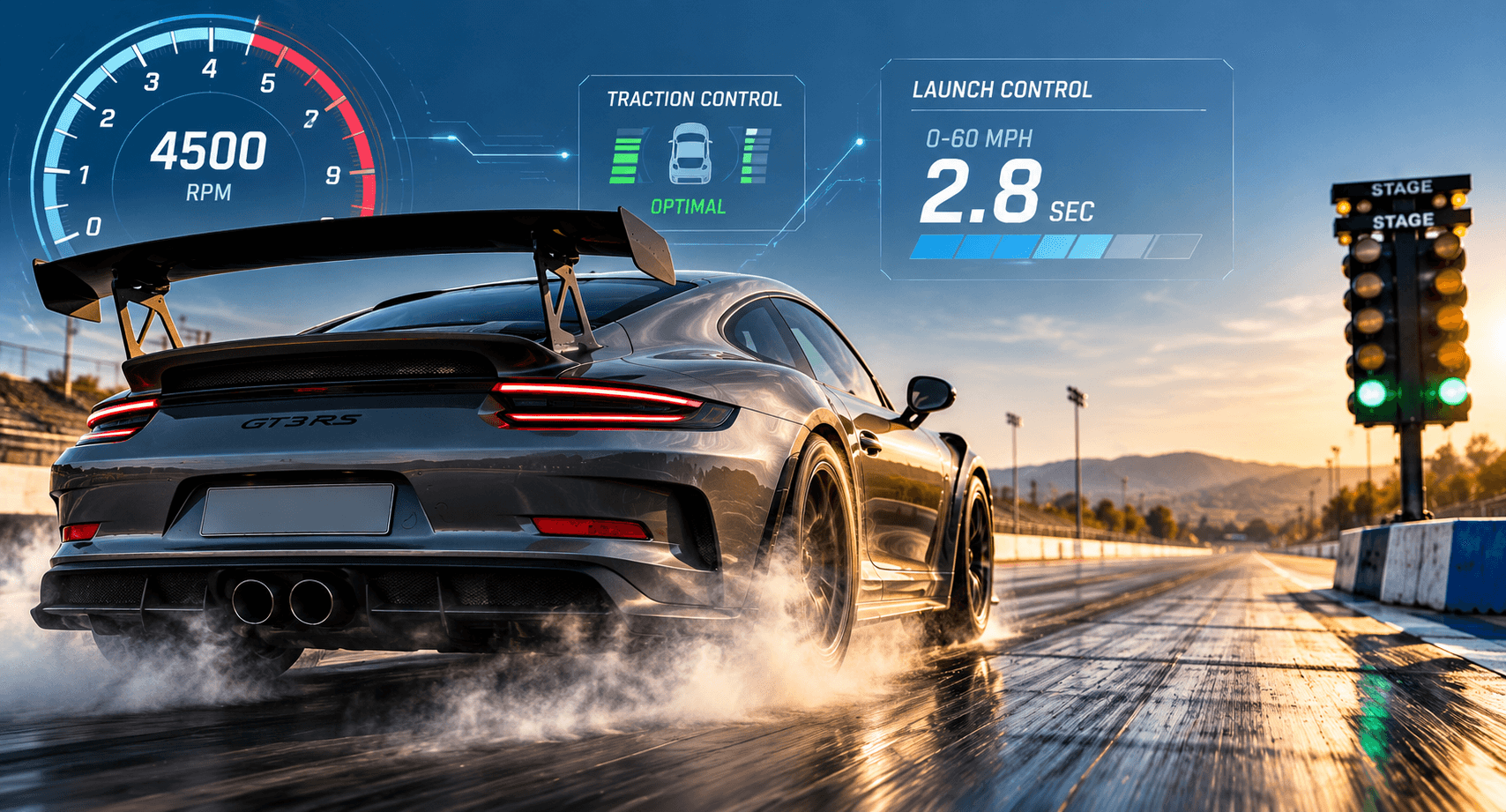
Modern performance cars are capable of accelerating far faster than many earlier generations of sports cars. Powerful engines, sophisticated transmissions, advanced tires, all-wheel-drive systems, and electronic controls have transformed how vehicles put power onto the road. One technology that brings many of these systems together is launch control.
Launch control is designed to help a performance vehicle achieve a controlled and repeatable standing start. Instead of leaving the driver to manually balance throttle input, engine speed, clutch engagement, and traction, the vehicle’s electronic systems coordinate these factors automatically.
The technology has become increasingly common in high-performance cars, including vehicles with conventional combustion engines, hybrids, and fully electric powertrains. Porsche’s current model range, for example, lists launch-control acceleration figures for several performance-oriented electric and hybrid models. Porsche explains several of its modern performance technologies.
What Is Launch Control?
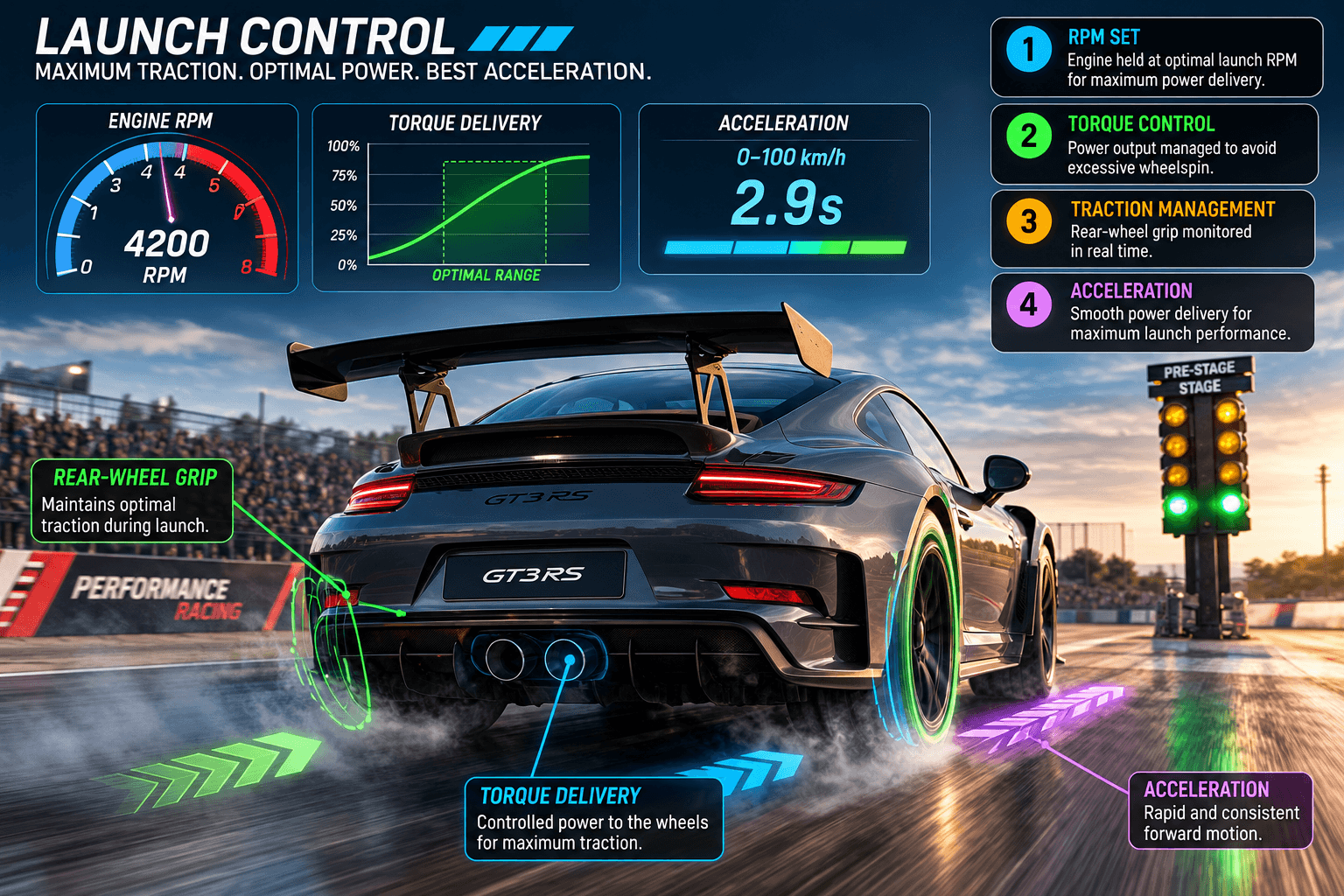
Launch control is an electronic vehicle system designed to optimize acceleration from a stationary position. It coordinates several parts of the powertrain and traction-control system to help the vehicle accelerate efficiently while limiting excessive wheelspin.
The exact operation differs between manufacturers and vehicle types. A launch-control system may manage engine RPM, throttle position, clutch engagement, transmission shifts, torque delivery, and traction control.
The objective is not simply to produce maximum engine power. The vehicle must also find a way to transfer that power through the tires without overwhelming available grip.
Why Wheelspin Is a Problem
When an engine produces more torque than the tires can transmit to the road, the driven wheels can spin. Some wheelspin may be useful in certain situations, but excessive wheelspin wastes available power and can make acceleration inconsistent.
Launch control attempts to manage this balance. Rather than allowing the driver to apply maximum throttle immediately and hope the tires maintain grip, the vehicle’s control systems regulate power delivery during the initial acceleration phase.
How Launch Control Manages Engine RPM
Engine speed is an important part of a successful launch. If the RPM is too low, the engine may not produce enough power to accelerate the vehicle effectively. If it is too high, the tires may struggle to maintain traction.
Launch control can hold the engine at a predetermined RPM or manage torque electronically so the vehicle begins its acceleration within an appropriate operating range.
The exact RPM target depends on the engine, transmission, tires, drivetrain configuration, and manufacturer calibration.
This means launch control is not simply a high-RPM starting mode. It is a coordinated system designed around the characteristics of the entire vehicle.
Launch Control and Traction
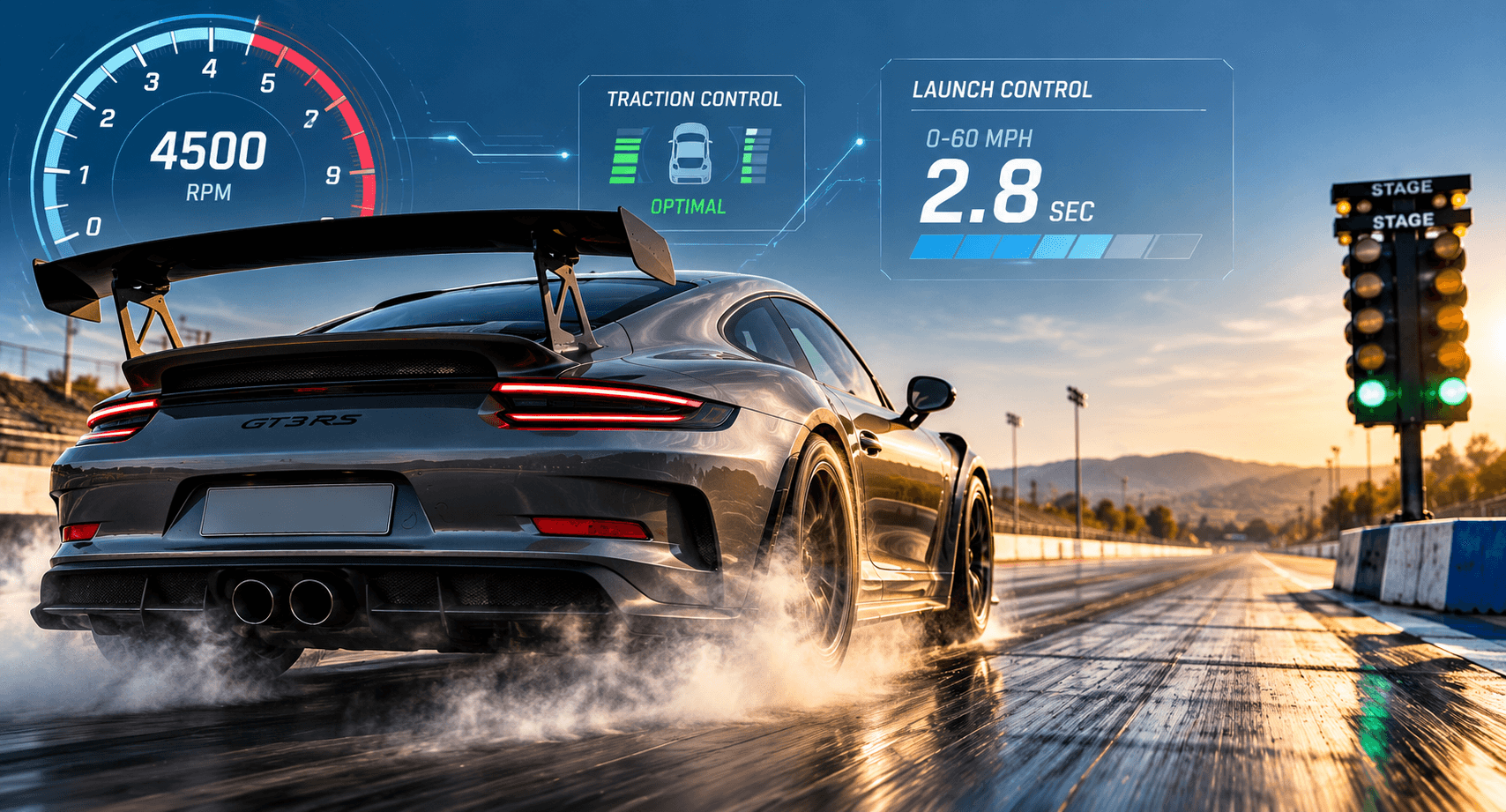
Traction is one of the most important factors during a hard launch. A vehicle can have substantial horsepower, but that power is only useful if the tires can transmit it to the road.
Launch control can work with traction-control systems to reduce unnecessary wheelspin. Sensors monitor wheel speeds and other vehicle conditions, allowing electronic systems to adjust torque delivery when traction begins to decrease.
This is particularly useful for high-powered sports cars because the amount of available engine torque can exceed the traction available from the tires during the first moments of acceleration.
For more information about how drivetrain technology manages traction, see our article on limited-slip differentials and sports car traction.
How Launch Control Works With the Transmission
The transmission plays a major role in launch performance. A vehicle with a fast-shifting automated transmission can coordinate gear changes with engine output during acceleration.
Many modern performance cars use dual-clutch transmissions, which can change gears extremely quickly. Launch control can work with the transmission software to determine when and how those shifts occur.
Our guide on dual-clutch transmissions in sports cars explains how two-clutch gearboxes prepare and execute rapid gear changes.
Manual vs Automatic Launches
Traditional manual transmissions require the driver to coordinate clutch release, throttle input, and gear selection. An experienced driver can perform a fast launch, but consistency depends heavily on technique and conditions.
An automated transmission can handle many of these tasks electronically. Launch control adds another layer by coordinating the transmission with engine and traction systems.
This does not necessarily make one transmission type universally better. Instead, it demonstrates how modern electronic controls can make high-performance acceleration more repeatable.
How Launch Control Works With All-Wheel Drive
All-wheel-drive performance cars can have an advantage when launching because torque can be distributed across multiple driven wheels. Instead of relying only on the rear tires, the system can use both axles to transfer power.
Launch control can coordinate torque distribution with the all-wheel-drive system. The exact strategy varies between vehicles, but the goal is generally to maximize usable traction during acceleration.
This is one reason many modern high-performance all-wheel-drive vehicles can produce extremely quick acceleration figures.
Launch Control in Electric Performance Cars
Electric performance vehicles introduce another approach to launch control. Electric motors can deliver torque almost immediately, eliminating some of the traditional challenges associated with engine RPM and clutch engagement.
However, managing that torque remains important. Excessive wheelspin can still reduce acceleration, particularly in powerful rear-wheel-drive electric vehicles.
Modern electric performance cars can therefore use software to coordinate motor output, traction control, battery power delivery, and drivetrain behavior.
Porsche’s current electric lineup provides examples of vehicles that advertise acceleration figures using launch control. Its Philippine model information lists launch-control performance for several Taycan variants. See Porsche’s current model and performance information.
Launch Control and Hybrid Performance Cars
Hybrid performance vehicles add another layer of complexity. A hybrid system can combine an internal-combustion engine with one or more electric motors.
The electric motor can provide immediate torque while the combustion engine contributes additional power. Launch-control software can coordinate these sources to deliver a controlled acceleration event.
This technology is becoming particularly relevant as manufacturers use hybrid systems to improve both performance and responsiveness.
For example, Porsche’s current performance models include hybrid systems that combine electric assistance with conventional powertrains. The company’s 2026 911 Turbo S uses T-Hybrid technology alongside an eight-speed dual-clutch transmission. :chatgpt-content-reference{index=”2″}
Why Launch Control Can Produce More Consistent Acceleration
One of the biggest benefits of launch control is consistency. Human drivers can vary their throttle input, clutch release, and shifting technique from one attempt to another.
Electronic control systems can repeat the same programmed strategy under similar conditions. This makes acceleration testing more repeatable.
However, launch performance can still vary because road surface, tire temperature, tire condition, vehicle load, weather, and battery or engine temperature can all affect traction and power delivery.
Does Launch Control Damage a Performance Car?
Launch control places significant demands on the drivetrain. Hard launches can generate substantial loads through the engine, transmission, axles, differential, and tires.
Manufacturers design launch-control systems with mechanical limits in mind, but repeated launches can still contribute to component wear.
Drivers should therefore follow the manufacturer’s instructions regarding launch-control use and maintenance. It is also important to understand whether a vehicle has specific limitations on repeated launch-control activation.
Heat Is Another Consideration
Repeated hard acceleration can generate heat throughout the drivetrain. Transmission components, clutches, differentials, tires, and brakes can all experience additional thermal stress during aggressive driving.
This makes thermal management important for performance vehicles. Our guide on high-performance cooling systems explores how performance cars manage heat under demanding conditions.
Launch Control vs Driver-Controlled Acceleration
Launch control is not necessary for every fast start. A skilled driver can modulate throttle input and manage traction without using the system.
The advantage of launch control is that it provides an electronic strategy designed specifically for the vehicle. It can coordinate systems that would otherwise require the driver to manage independently.
For everyday driving, this technology may rarely be necessary. It is primarily relevant to performance testing, controlled acceleration, and situations where the driver wants to explore the vehicle’s maximum standing-start capability in an appropriate environment.
How Tires Affect Launch Control
Launch control cannot overcome the physical limits of the tires. Tire compound, temperature, tread condition, pressure, and road surface all influence available traction.
A vehicle equipped with a sophisticated launch-control system can still struggle for grip if its tires are cold or the road surface is wet.
This is why tire selection remains important even when a car has advanced electronic performance systems. Our article on performance tires and driving experience covers the role tires play in acceleration, braking, and cornering.
Launch Control and Track-Day Driving
Launch control can be interesting for track enthusiasts, but it is not necessarily the most important technology for improving lap times. Most racetrack driving involves repeated cornering, braking, acceleration, and maintaining consistent vehicle balance rather than standing starts.
For a track-focused setup, tires, brakes, suspension, cooling, and driver technique can be equally important or more relevant depending on the circuit.
Our guide to 2026 track-day upgrades explores several of the systems that influence performance during repeated track sessions.
What Sports Car Buyers Should Know About Launch Control
For someone shopping for a performance car, launch control can be an interesting feature, but it should not be evaluated in isolation. Buyers should consider the complete powertrain, transmission, drivetrain layout, tires, braking system, suspension, and intended use.
A car with launch control may offer impressive acceleration numbers, but the driving experience involves much more than a single acceleration test.
When comparing performance vehicles, it can also be useful to understand how the system behaves during normal driving. Some performance technologies are designed primarily for maximum acceleration, while others influence the vehicle throughout everyday use.
For more vehicle-selection guidance, visit the Car Buying Advice section of AutosportReviews.
Final Thoughts
Launch control is a good example of how modern performance cars combine mechanical hardware with sophisticated software. Rather than relying entirely on engine power, the system coordinates RPM, throttle, transmission behavior, traction control, and drivetrain response to manage acceleration from a standstill.
The technology is now found across a wide range of performance vehicles, including gasoline-powered sports cars, hybrids, and electric models. As power outputs continue to increase, electronic control becomes increasingly important for turning available power into usable acceleration.
Launch control does not eliminate the importance of tires, drivetrain components, or vehicle setup. Instead, it works with those systems to manage the difficult transition from stationary to high-speed acceleration.
For performance enthusiasts, understanding how launch control works provides another perspective on modern automotive engineering. The next time you see an impressive acceleration figure from a new sports car, remember that the result is not simply about horsepower. It is also about how effectively the vehicle can manage and transfer that power to the road.